
Picture this, you’re confiding in a digital assistant about your worries, and it responds by deciphering your emotional state. This isn’t a futuristic daydream — artificial intelligence (AI) is already subtly reshaping psychology.
No longer confined to sci-fi imaginings, AI has etched its mark on the realm of mental health, from therapy to diagnostics, raising compelling ethical questions along the way.
So, what does AI’s quiet revolution imply for our future?
We’ll explore that by delving into AI’s concrete psychological applications, ethical concerns, and the dare-to-dream landscape of tomorrow. The intersection of AI and psychology isn’t some far-off crossroad — we’re standing right in the middle. Buckle up for the journey.
Unwrapping AI’s Roles in Mental Health
Surely, AI’s mark on psychology extends beyond digital assistants capable of interpreting your emotions. Let’s highlight a few noteworthy areas where artificial intelligence, seamlessly weaved into psychological practice, ushers change.
- Predictive Analytics for Relapse: Remember bad habits aren’t that easy to break? They tend to creep back into our lives when least expected. Here AI lends a helping hand. By constructing patterns based on evidence collected over time, AI can anticipate relapses. That way, custom preventive measures can be set in motion before your old friend, the bad habit, knocks on the door again.
- AI-Driven Diagnostic Tools: Picture a world where mental health issues are detected and addressed before they mushroom into debilitating conditions. With AI creating such diagnostic tools, early detection of mental health conditions is no longer wishful thinking. These tools, trained on vast datasets, can pick up subtle hints that might elude the human eye, bolstering accuracy, and speed of detection.
- Personalized Treatment Plan Generation: Imagine a therapy plan meticulously tailored to your unique needs. AI writes a new chapter in therapy by going beyond one-size-fits-all solutions. It parses through your personal journeys, medical history data, and symptom patterns, crafting a treatment plan drenched in personalized care.
- Virtual Reality Exposure Therapy Enhanced by AI: For those reluctant to face their fears or traumas directly, the virtual world offers a perfect workaround. AI propels virtual reality experience by accurately mirroring real world scenarios. This enables controlled exposure to fear triggers, reducing anxiety and advancing therapy outcomes.
Think of these areas as the stepping stones towards a future where AI optimizes mental-health care down to a science. AI isn’t merely framing a new narrative in psychology–it’s proving that this narrative can be rich, efficient, and most importantly, deeply personal.
AI in Therapy: Benefits and Challenges
We can’t deny that AI has the potential to transform the mental health domain, enhancing efficiency, offering advanced data analysis, and increasing accessibility. That said, this technology isn’t without its drawbacks, such as ethical dilemmas, data privacy concerns, and a potential loss of the ‘human touch’ in therapy.
Let’s break down these contrasts.
| Pros – The Upside | Cons – The Downsides |
| AI can speed up diagnostics and treatment, freeing up professionals’ time for in-person sessions. | AI might lead to over-reliance on technology, threatening the essential human component in therapy. |
| It delivers sophisticated data analysis, helping to tailor treatment plans to individual needs. | Without the right safeguards, data privacy issues could emerge troubling both professionals and clients. |
| AI broadens the reach of therapy, bringing support to remote or underserved populations. | Its use in mental health is bound with ethical dilemmas: how much autonomy should machines have in diagnostic and therapeutic contexts? |
This dichotomy is something all psychology professionals must reckon with. As AI continues to reshape mental health practices, striking a balance between utilizing AI for its undeniable benefits and mitigating its challenges will determine the future of therapy.
AI and Ethics: Psychological Trepidations
When we weave artificial intelligence into the very fabric of mental healthcare, we can’t ignore the darker threads that come along. One glaring issue is the innate bias in AI algorithms. Trained on vast datasets, these algorithms could re-infuse societal biases into mental healthcare decisions, potentially leading to misdiagnosis.
Designing algorithms void of prejudice is a formidable challenge, but that’s not the only hurdle. How do we ensure data privacy and security for patients whose personal experiences, fears, and vulnerabilities are in the hands of a digital entity? This data, so sensitive and integral to patient identities, could be potentially misused or leaked, causing breaches of trust.
The patient-therapist relationship sits at the heart of mental healthcare, fostering a safe space for recovery and growth. However, introducing an AI entity into this intimate equation could significantly reshape, even threaten, this dynamic.
As AI invades the realm of psychology, we need robust regulatory frameworks to oversee its deployment. Mindful of AI’s potential risks, it’s imperative to maintain an ongoing vigilance, ensuring technology serves as an ally, not an adversary, in our pursuit of mental well-being. Let’s tread with thoughtful caution as we navigate the future of therapy.
AI in Therapy: Common Myths and Realities
AI in therapy is a subject shrouded in myths and misconceptions. The first myth to dispel is that AI will fully replace therapists. Rather than replacing, AI helps to augment a therapist’s expertise, giving them more time for complex cases that require a human touch.
Next, the assumption of infallible objectivity in AI should be put to rest. Contrarily, artificial intelligence does inherit human biases as it’s created and shaped by us, subject to the quirks of our unique perspectives.
Lastly, some worry that AI could turn therapy into an impersonal process. However, AI can actually equip therapists with the capacity for deeper human connections. By handling some tasks, AI can free up therapists, allowing them a significant amount of time to actively listen and empathize with their clients.
So, rather than fearing AI in therapy, consider its application as a dynamic tool created to serve us, let’s shift our perspective and embrace AI as a means to enhance, not replace, the human element in mental health care.
From Theory to Practice: Steps for Psychology Professionals to Adopt AI
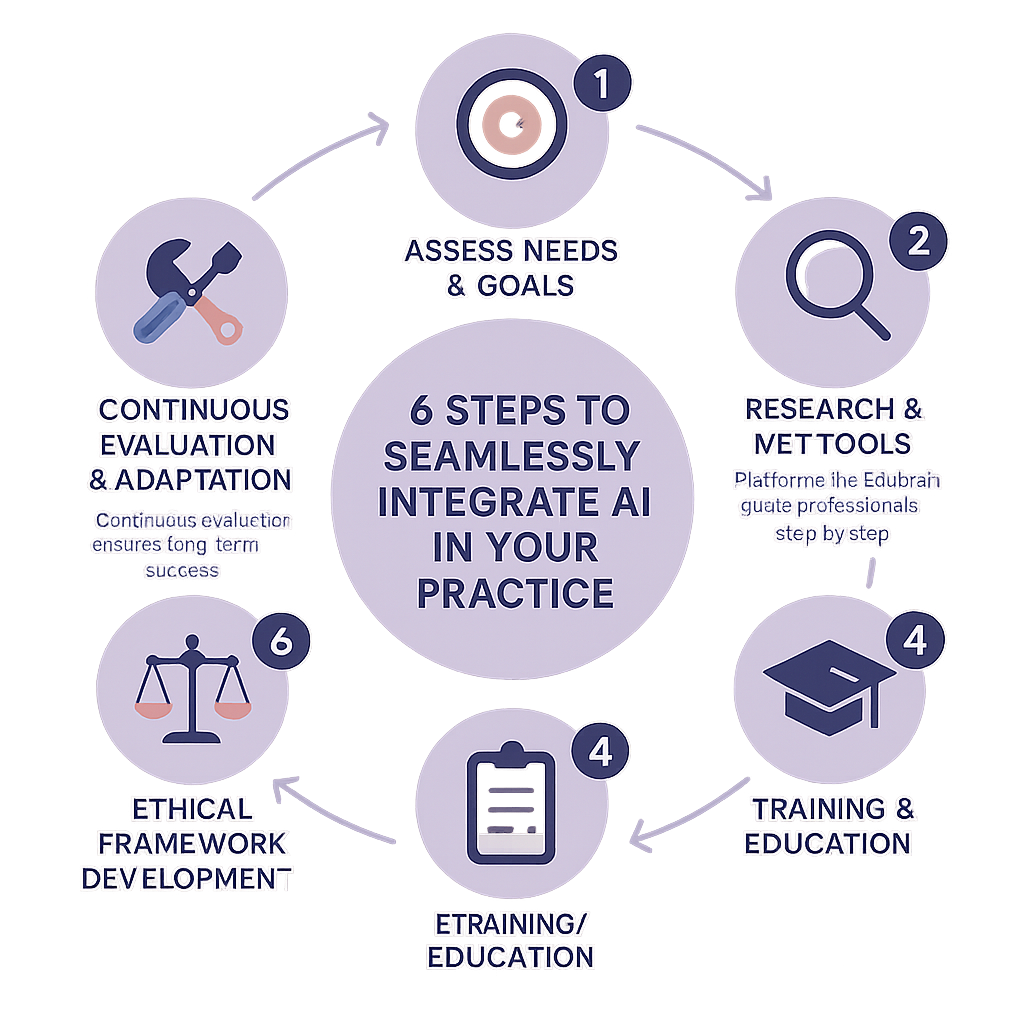
Thinking about incorporating artificial intelligence in your practice? These six practical steps can guide you on an effective path.
First, it’s critical to assess your needs and goals. Identify areas where AI could possibly mitigate pain points. Explore whether it’s reducing administrative tasks, streamlining diagnostics, or other areas where you’d like to improve efficiency.
Step two requires some homework on your part. Research and vet AI tools available in the market. Look for how well they meet your identified needs. A platform called Edubrain could illuminate your path here. Stepping through the world of AI applications in psychology, it can guide you to suitable tools, strategies for adoption, and invaluable resources on ethical guidelines.
Once you’ve found a potential tool, start small. Implement a pilot program as your third step. This smaller scale approach can help identify any unforeseen issues before a wider rollout.
In tandem, invest in the fourth step – training and education for your staff. They need to understand this new AI tool, its benefits, and how to use it effectively.
Next, you must develop an ethical framework. Technology brings novel dilemmas, and having a guideline in place will aid in navigating these unprecedented terrains.
The last step revolves around constant evaluation and adaptation. Fine-tuning your integration should be an ongoing process, as AI technology, your practice, and patient needs are dynamic entities.
Remember, harnessing the potential of AI is not a single event but an exciting journey that promises to reshape the future of psychology. Keep iterating as you learn and adapt along the way.
Early Anxiety Detection: A Tale of AI in an Adolescent Clinic
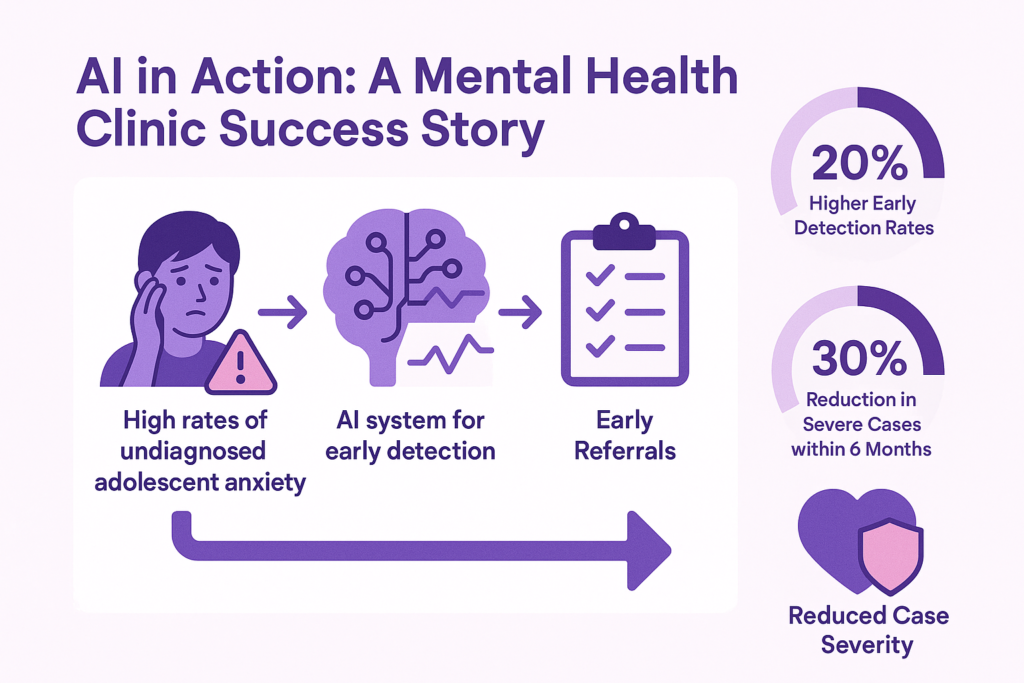
A mental health clinic, addressing the rising epidemic of anxiety among today’s adolescents, decided to venture into the realm of AI-based solutions. Their main concern revolved around the critical stage of early intervention, which promised to lower long-term severity, but was often missed due to late discovery.
In their quest, they partnered with a tech company, specialized in personalized mental health solutions. An AI-based platform was introduced, equipped to scan preliminary patients’ screenings and identify at-risk adolescents. It was calibrated to recognize subtle changes in language usage and emotional tone from individual’s input during digital interactions, triggering alerts when potential symptoms were detected.
The staff trained to use this new tool, and in due time, the results began to surface. They experienced an upward trend in early referrals and noticed a robust reduction in the severity of anxiety cases. The clinic was better equipped to intervene promptly, ultimately creating a more proactive treatment environment.
Facing the challenges head-on, the clinic became a beacon of hope, utilizing AI not as a replacement for human intervention but as an empathetic comrade in the pursuit of holistic mental healthcare. AI wasn’t an intruder here; it was a friendly decision-support tool contributing to their mission.
Businesses and Machines: A Symbiotic Future in Therapy
You might still be questioning whether AI can truly enrich the therapeutic process. Let’s paint a picture of what could it look like in the future.
Primarily, AI shouldn’t be seen as a threat to human psychologists but rather an enhancement of their capabilities. Machines sift through complex data, allowing therapists to target the root of the issue faster. With the time saved, they can dive deep into the emotional concerns of their clients.
Moreover, envision AI-driven diagnostics acting as therapists’ right-hand, aiding to more precise understanding of patients’ mental health progression. Bringing light to unseen patterns, or even projecting possible treatment outcomes based on past cases, AI could bring unprecedented support for personalizing mental health care. In this view, AI is not supplanting human connection but is advocating for it, helping us create a more accessible and effective mental health care system.
However, this AI-touched future comes with a caveat. Just as every tool, it will only serve as good as we wield it. It’s our collective responsibility, as both developers and users of these AI tools, to proceed with thoughtful caution. By striking this delicate balance, the future of psychology seems robust, filled with potential breakthroughs facilitated by the thoughtful application of AI.
A Smarter Practice: The Crucial Insights
1. Adopting AI into psychological practices enriches the therapeutic process. Machines’ ability to parse complex data swiftly paves the way for therapists to pinpoint the heart of issues promptly, allowing more time for exploring their clients’ emotional landscape.
2. AI-influenced diagnostics empower therapists with precision, illuminating patients’ mental health progress unseen before. This tool does not replace, but rather strengthens human connection and accessibility in mental health care.
3. The promise of AI support comes with a requirement of responsible use. As beneficiaries of these tech advancements, it falls on us to utilize AI conscientiously. Carrying this caution forward ensures a future where human mental health thrives, bolstered by AI’s careful application.