
By 2025, 80% of all health care encounters will incorporate AI in some form, as reported by IDC Health Insights. This statistic might lead you to picture a chilling future where conversation and empathy are replaced by the sterile interaction with machines.
Yet, this is not a narrative about job replacement. Instead, consider this a strategic guide to adapting and optimizing the future of psychology.
The rapid influx of AI in mental health speaks not of an impending AI-induced job loss but of a new era of augmented psychology practice. Equipping oneself for advancement in this age of AI is no longer a luxury; it becomes a necessity.
When we peel back the layer of hype, AI is not just a wave to ride out, but a tide that is transforming the way we practice psychology.
AI Offers Assistance, Not Substitution
AI’s core strengths lie in data processing, pattern recognition, and automated repetition of tasks. For example, it can analyze initial screening responses or sift through vast amounts of data to find significant patterns, freeing up the human practitioner for higher-value tasks. By contrast, human psychologists bring empathy, complex ethical reasoning, an ability to build a therapeutic alliance, and a nuanced understanding of individual experiences to the table.
A clear distinction exists. AI excels at determining ‘what’ is happening, spotting patterns in symptoms, behavior, and responses. Meanwhile, psychologists master the ‘why’ and ‘how’ of therapeutic contexts—teasing out causes, examining influences on behavior, and identifying suitable treatment strategies.
While AI may tell a patient they have exhibited signs of anxiety based on certain response patterns, a human psychologist brings understanding and nuance to this revelation. They understand the implications, empathize with the emotional struggles, guide the patient through coping strategies, and design bespoke therapy plans tailored to individual situations.
So here’s the nutshell: AI in mental health is not about replacing human expertise; rather, it augments the efforts of psychology professionals. This assistance frees up time, increases efficiency, and allows psychologists to focus on what they do best—connect, empathize, and creatively shape patient-centric treatment plans. It’s another tool in the kit for today’s psychologists, a faithful assistant in navigating the future of therapy.
Specific Spheres Where AI is Influencing Psychology
Let’s dig right into the key arenas where AI is already making an impact or is on the cusp of revolutionizing the practice of psychology.
- Pattern recognition in patient data, aiding in diagnostics. By interpreting behavioral patterns and survey responses, AI can support psychologists in the initial screening and diagnosis of mental health conditions.
- Administrative aspects like scheduling or billing, often viewed as mundane, can be swiftly automated. AI applications can seamlessly manage appointments and handle invoicing, giving practitioners more time for meaningful patient interactions.
- When it comes to exploring large data sets, AI can identify trends that may be overlooked by the human eye. Such insights can drive future research in mental health.
- AI-powered applications can deliver personalized intervention, particularly for cognitive behavioral therapy exercises. These applications provide engaging, user-friendly exercises for clients to practice between therapy sessions.
- Predictive analytics is another area where AI shows promise. It can flag potential at-risk populations based on data patterns, enabling early intervention and proactive mental health strategies.
From these examples, it’s clear that AI is not just a random trend or a fleeting buzzword in psychology professions. It’s a transformative force, reshaping traditional practices and opening avenues for augmented psychology practice.
As we venture further into this AI-infused landscape, upskilling becomes a critical investment for professionals looking to leverage these tools and stay relevant in their field.
Hybridization: The Future of Psychology Professions
Imagine a therapist who can expertly leverage artificial intelligence to augment and streamline their practice. It’s not some far-off fantasy; it’s already happening in the form of blended psychology professionals.
Take Dr. Anya Sharma, an AI Ethicist in Psychology – she champions the need for interdisciplinary skills as being crucial in the evolving landscape of mental health. “Technology enhances our capabilities. Deep psychological understanding and tech-literacy together can make a profound impact,” she asserts.
Consider the following roles that didn’t even exist a few years ago: An ‘AI-Assisted Therapist’ integrates algorithmic insights into their therapeutic strategies, creating a more tailored approach for each patient. A ‘Psychometric AI Developer’ constructs AI tools that accurately measure mental health markers in ways us humans might miss. A ‘Digital Therapeutics Designer’ creates, tests, and fine tunes AI-based applications for mental health guidance.
Meanwhile, an ‘Ethical AI Consultant for Mental Health’ steers the development and use of AI tools onto an ethical track, ensuring that technology serves the mental well-being of humans and respects their rights faithfully.
Here’s the catch: these roles aren’t just about understanding AI. They require a sturdy foundation in psychology to use AI as a means of enhancing rather than replacing human insight. Interdisciplinary, hybrid roles like these are what’s coming. It’s a powerful synthesis of human understanding and artificial intelegence, set to shape the future of psychology careers.
AI Integration: A Five Step Approach
Do you find yourself thinking ‘how will AI affect psychology jobs’? Remember, adapting to change is not daunting with a clear roadmap in hand. Let’s walk through a step-by-step guide designed to help professionals cultivate a skill set tailored for the AI era.
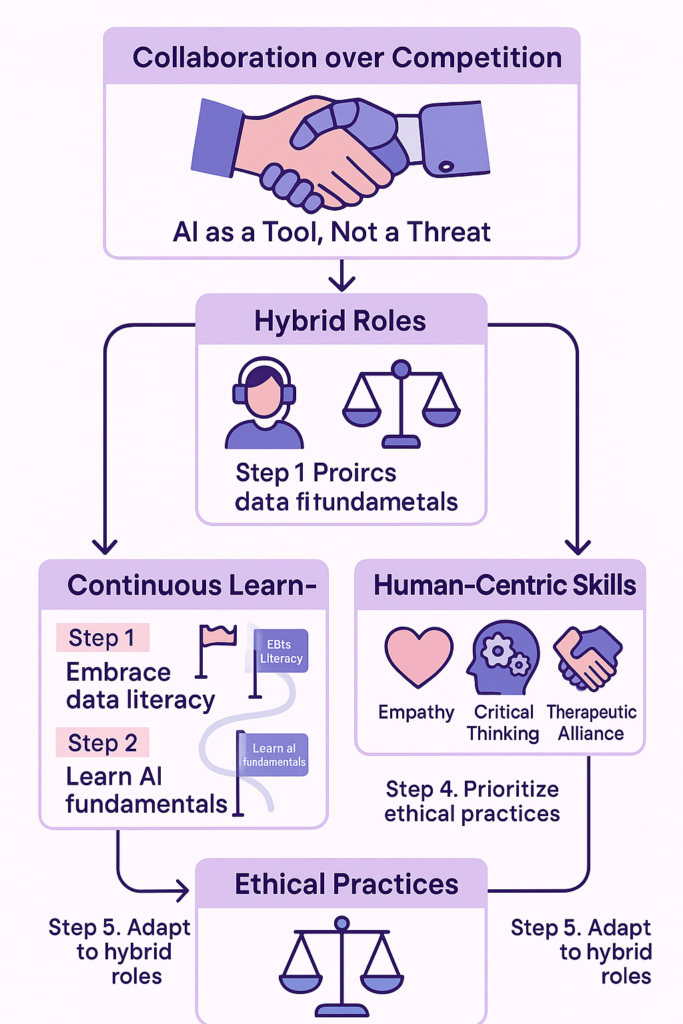
1. Start by getting comfortable with data – understand basic statistical concepts, interpretation techniques, and data visualization. Integrating data literacy can make navigating AI outputs less intimidating.
2. Next, grasp the fundamentals of AI. Comprehend how these models function, their limitations, and their ethical implications. This understanding will help you critically evaluate AI tools and applications within your field.
3. Learn ‘Prompt Engineering’. Your ability to communicate effectively with AI tools could greatly amplify your results. The right prompts can extract highly valuable insights from AI.
4. Fourth on the list is developing an understanding of Digital Ethics. Navigating issues such as privacy, bias, and consent in AI applications is a crucial skill for the modern therapist.
5. Last, but certainly not least, amplify your human-centric skills. Double down on skills AI cannot mimic, like empathy and critical thinking. A strong therapeutic alliance cannot be replaced by any technology.
Let’s not forget resources like Edubrain to support this learning journey. Edubrain offers specialized courses and certifications, such as AI ethics for mental health, and prompt engineering for therapeutic applications.
This platform equips psychology professionals to stay ahead and proactively adapt to AI in mental health. The future of psychology with AI is not just about the tools, it’s about the human expertise steering its ethical and effective use.
Demystifying AI: Common misconceptions in mental health
There’s an undercurrent of false beliefs swirling around AI in mental health. It’s time to dispel some myths and shine a spotlight on the facts.
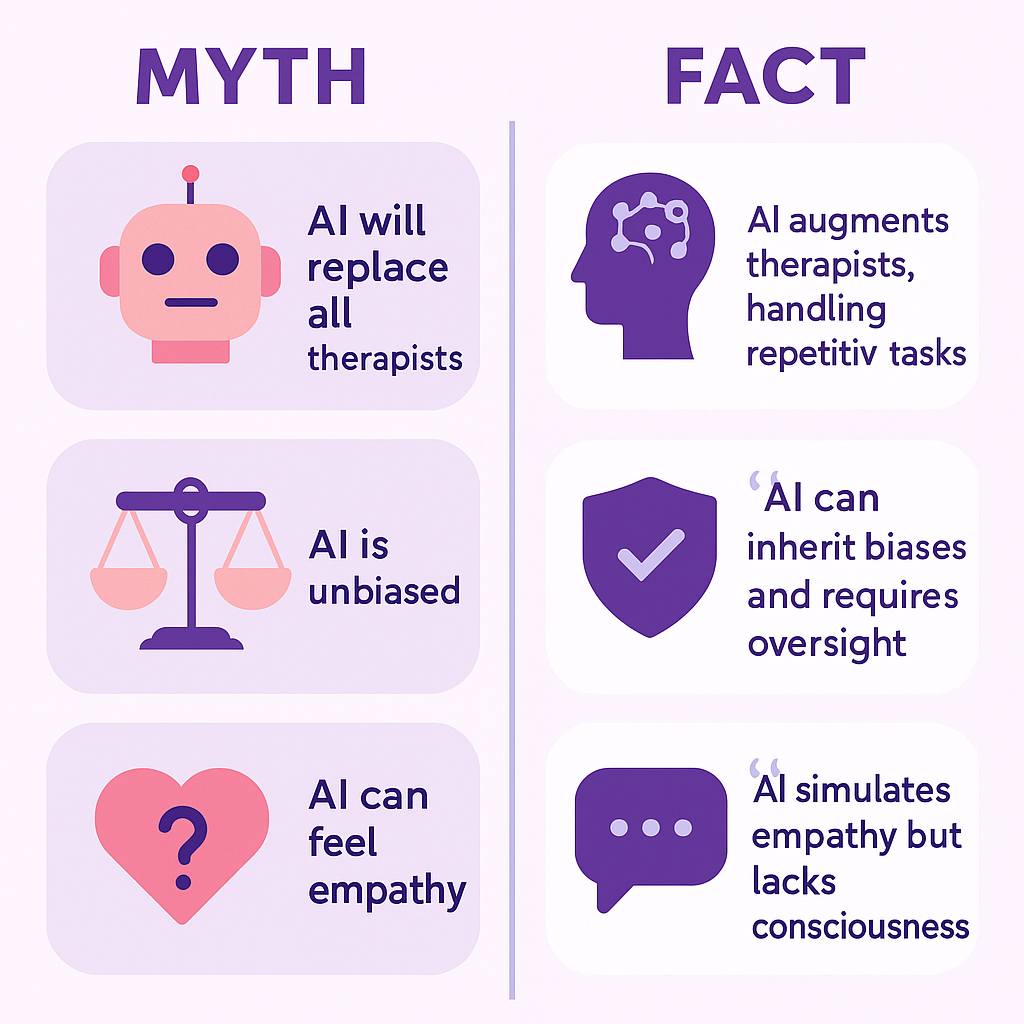
The fear that AI will push all therapists into obscurity is a popular myth. In reality, AI comes as an aide to therapists. It takes over repetitive tasks while gleaning insights from vast pool of data, letting therapists focus more on what they are best at – offering empathy and understanding.
Another misconception – AI is free from any human-like bias. This couldn’t be farther from the truth. If not meticulously managed, AI can very well carry and intensify human biases, making ethically sound AI development and implementation crucial.
Finally, there’s this belief that AI can feel empathy. The truth? AI can only simulate empathy. It doesn’t possess the inherent understanding or consciousness to truly empathize. AI shouldn’t be seen as a threat but viewed as an ally, a tool that therapists can harness to help steer mental health treatments into a vibrant and technologically enhanced future.
Ethics: The Underrated Pillar of AI in Psychology
As we delve into the dynamic sphere of AI in psychology, a significant emphasis must be placed on ethical considerations. The integration of AI brings up several ethical points of concern that psychologists must grapple with – these span from patient privacy to data security, algorithmic bias, and informed consent for AI-assisted interventions.
Substantial care must be taken when dealing with confidential patient information. With AI tools, the chances of breaching data security rise – an added responsibility for practitioners to safeguard sensitive patient records. Furthermore, algorithmic bias is another prominent ethical implication. It’s critical to remember that AI tools, built from human-fed data, are prone to inherent biases. Unchecked, these can perpetuate pre-existing prejudices, resulting in skewed diagnoses and treatments.
Informed consent takes on a new dimension with AI. Patients must be made thoroughly aware of the use of AI in their treatment plan – its benefits, potential risks, and limitations. Such full disclosure is paramount to upholding trust in the AI-augmented therapeutic alliance.
Moreover, the individual practitioner’s responsibility while employing these AI tools cannot be downplayed. They are behind the wheel, steering the ethical use of AI in their practice. This underscores that ethical oversight isn’t a bonus skill – it’s a core competency required for future psychologists navigating the intersection of therapy and AI.
In short, the field of psychology is witnessing an AI revolution, one that necessitates a steadfast moral compass. As practitioners, the responsibility to uphold ethics is integral to leveraging AI to resourcefully augment mental health care while maintaining the integrity of the profession.
Embracing AI: Essential Insights for Future Psychologists
Let’s condense the essentials we’ve discussed into bite-sized takeaways. Regard AI as a collaborative colleague, not a replacement, for human psychologists. Realize your enriched role in the future of psychology careers as they not only need your mental health proficiency, but also hunger for your technological literacy.
Embark on a continuous learning journey to mitigate unpredictable, stringent ethics concerns amplified by AI in mental health. Shine at uniquely human skills such as empathy and critical thinking. Topping it all, believe in your power to leverage AI to extend – not eclipse – your practice. As psychologists of the future, you ought to make AI your ally.
With these insights, you stand poised to ride the wave of change, steering the course of your profession.
Psychologists and AI: Crafting the Future of Care Together
So here we are, navigating the crossroads of tech and psychology in an attempt to reshape our future. This dual journey is yours to embark upon, a shift not just towards embracing AI but defining its role in our profession.
Dissolving the barriers of fear and uncertainty, psychologists can stand tall, collaborating with artificial intelligence, steering the advancement of technology in mental health, and crafting a more robust and accessible healthcare model. The future of psychology applauds your expertise, your empathy, and your irreplaceable human touch.
Let’s not forget, it’s up to us to shape AI, integrating it seamlessly into our practice. The future isn’t strictly about AI. It’s about us creating bridges—psychologists and AI carving the future of mental healthcare, together.